
Low back pain can feel like a giant question mark. Is it a muscle strain? A disc issue? Or something with a long, hard-to-pronounce name that you heard once and promptly forgot?
Two conditions that often get mixed up are spondylolysis and spondylolisthesis. They’re related, they sound almost identical, and they often involve the same area of the spine—but they are not the same thing. Understanding the difference can help you make sense of your symptoms, imaging results, and treatment options.
Let’s break it down in plain English.
First, a Quick Spine Refresher
Your spine is made up of stacked bones called vertebrae. These bones protect the spinal cord, allow movement, and help support your body weight. Each vertebra has several parts, including a small section of bone called the pars interarticularis—think of it as a connecting bridge between joints in the spine.
That little bridge is where spondylolysis starts.
What Is Spondylolysis?
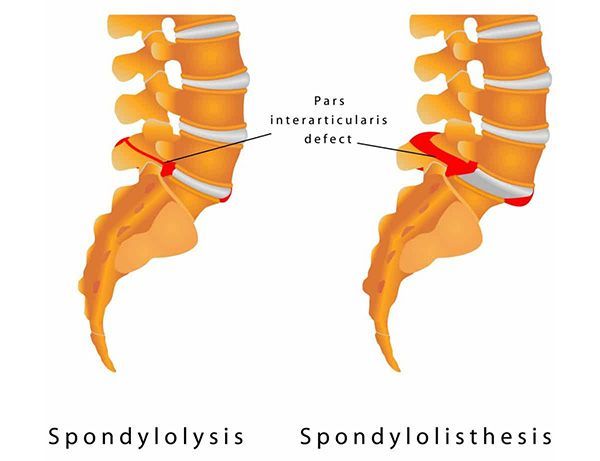
Spondylolysis is a stress fracture or defect in the pars interarticularis, most commonly in the lower lumbar spine (especially L5).
How Does It Happen?
Spondylolysis often develops from repetitive stress, not a single traumatic injury. It’s especially common in:
- Young athletes
- Gymnasts, dancers, football players, and weightlifters
- People who frequently extend or rotate their lower back
Symptoms of Spondylolysis
Here’s the tricky part: some people have no symptoms at all. Others may experience:
- Dull, aching low back pain
- Pain that worsens with activity or extension (arching backward)
- Tight hamstrings
- Stiffness after exercise
Because it doesn’t always cause pain, spondylolysis is sometimes found incidentally on X-rays or other imaging.
What Is Spondylolisthesis?
Spondylolisthesis occurs when one vertebra slips forward over the one below it.
This slippage can happen for several reasons, but one of the most common causes is—you guessed it—spondylolysis. If the pars fracture weakens the spine enough, it can allow the vertebra to shift out of place.
Types of Spondylolisthesis
While there are multiple types, two show up most often in chiropractic settings:
- Isthmic spondylolisthesis – caused by a pars defect (spondylolysis)
- Degenerative spondylolisthesis – caused by age-related changes in discs and joints
This blog focuses primarily on the isthmic type, since that’s where the spondylolysis vs. spondylolisthesis confusion usually comes from.
Symptoms of Spondylolisthesis
Symptoms depend on how much slippage has occurred. They may include:
- Low back pain
- Pain that radiates into the hips or legs
- Tight hamstrings
- Difficulty standing or walking for long periods
- In more severe cases, numbness, tingling, or weakness in the legs
Not everyone with spondylolisthesis has pain—but when symptoms show up, they tend to be more noticeable than with spondylolysis alone.
Key Differences at a Glance
Let’s simplify it:
- Spondylolysis= a stress fracture or defect in the bone
- Spondylolisthesis= a vertebra slipping forward
Think of spondylolysis as the crack in the foundation, and spondylolisthesis as what happens if that crack allows movement.
You can have:
- Spondylolysis without spondylolisthesis
- Spondylolisthesis that started as spondylolysis
- Spondylolisthesis without a pars fracture (degenerative type)
How Are These Conditions Diagnosed?
A thorough diagnosis starts with a detailed history and physical exam. Your chiropractor will ask about:
- Your pain pattern
- Activities that worsen or relieve symptoms
- Sports participation or repetitive movements
- Past injuries
Imaging may include:
- X-rays to look for pars defects or vertebral slippage
- MRI to assess soft tissues, discs, and nerves
- CT scans in more complex cases
Imaging helps confirm what’s going on, but symptoms and function matter just as much when creating a treatment plan.
Can Chiropractic and Massage Therapy Help?
Yes—in many cases, conservative care plays a major role in managing both conditions.
Chiropractic Care
Chiropractic treatment focuses on improving spinal mechanics, reducing stress on affected areas, and restoring movement where appropriate. Care plans may include:
- Gentle spinal adjustments (avoiding excessive extension when needed)
- Mobility work for restricted joints
- Postural and movement education
- Core stabilization guidance
The goal is not to “force” anything back into place, but to support the spine so it can function more efficiently and comfortably.
Massage Therapy
Massage therapy is an excellent complement to chiropractic care, especially for managing muscle tension associated with these conditions. Benefits may include:
- Reduced muscle guarding
- Improved circulation
- Relief of tight hamstrings, hip flexors, and low back muscles
- Improved overall comfort during movement
When muscles are calmer, the spine often moves better—and pain levels tend to follow.
What About Activity and Exercise?
For both spondylolysis and spondylolisthesis, movement matters—but the right kind of movement matters more.
Most patients benefit from:
- Core strengthening
- Hip and hamstring mobility
- Avoiding excessive spinal extension early on
- Gradual return to activity
Your chiropractor can help guide safe progressions and identify movements that may be aggravating your symptoms without you realizing it.
When Is More Aggressive Treatment Needed?
The majority of cases respond well to conservative care. However, referral to another provider may be appropriate if there are:
- Progressive neurological symptoms
- Significant or worsening slippage
- Severe pain that does not improve with conservative treatment
Your care team’s job is to help you navigate options—not push you into unnecessary interventions.
The Bottom Line
Spondylolysis and spondylolisthesis are closely related but distinct conditions. One involves a stress fracture, the other involves vertebral movement—and understanding the difference can make your diagnosis feel a lot less intimidating.
If you’ve been told you have one of these conditions (or suspect you might), you don’t have to navigate it alone. Chiropractic and massage care can play a valuable role in improving comfort, movement, and confidence in your spine.
If you have questions or want to know whether conservative care is a good fit for you, talk with your chiropractor at your next visit. Knowledge is power—especially when it comes to your back.
Bethany Wolcott
D’Youville Chiropractic ‘26